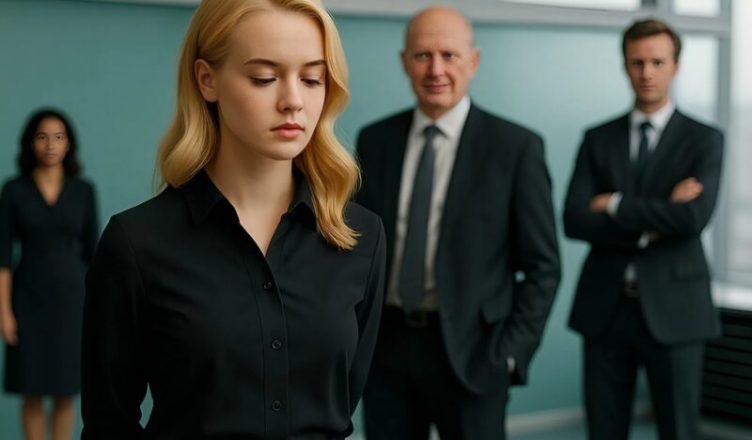
The same employees who had just been giggling and whispering now stood stunned, staring at the girl they had so casually dismissed.
The older man walked over and held out his hand:
— Good to see you back with us.
She lifted her gaze — steady, composed, quietly self-assured.
— Thank you, she said.
— Let’s go to my office, he replied, gesturing toward the elevator.
And then he paused — deliberately — and turned to the staff:
— Allow me to introduce her properly. This is Anna Sergeevna Krylova — our new co-owner.
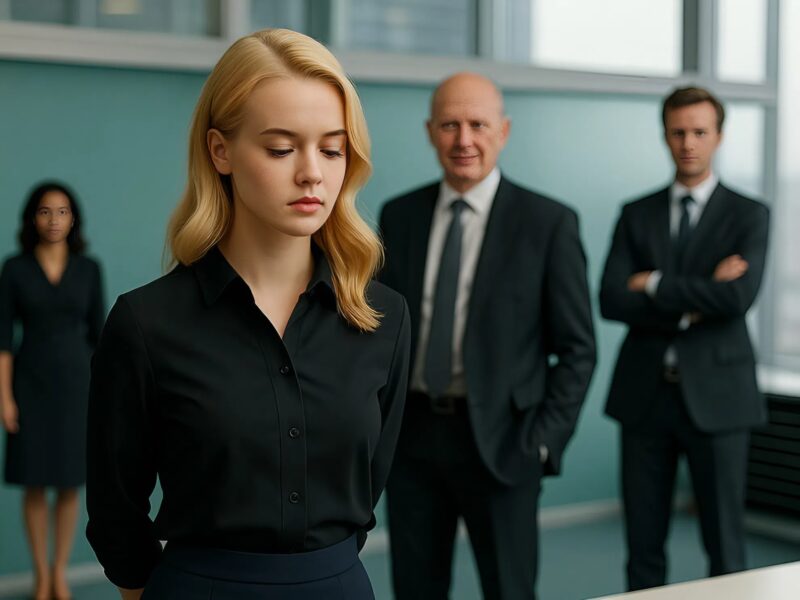
The reaction was immediate.
A spoon clattered into a cup.
Someone inhaled sharply.
A few exchanged horrified glances.
This girl?
This girl?
In a faded blouse and worn ballet flats?
It hadn’t always been this way.
Anna grew up without family, without connections — a product of foster homes and temporary guardians. At 17, she washed floors, waited tables, delivered groceries. Every spare coin went into her education.
And all that time… she was building something inside her mind.
She designed a compact, efficient optimization algorithm for supply logistics — a tool so simple and elegant that no one else had noticed its potential. Night after night, she worked at an aging laptop, studying economics, operational logistics, resource flow patterns. When employers mocked her for being “too ambitious,” she didn’t break — she sharpened.
Eventually, she sent her concept to the CEO of this very company. The email almost died in spam — the fate of many brilliant ideas. But by chance, the CEO himself opened it — a man old enough to remember that talent rarely arrives wearing gold.
He invited her to talk.
He questioned her projections. He pushed back against her assumptions. He demanded proof, logic, justification.
She delivered.
Her algorithm cut company costs by 18%, improved operational efficiency by 23%, and boosted profit margins significantly — all in just over a year.
And then came the turning point:
— I don’t want you here as an employee. I want you as a partner.
Once inside his private office, away from shallow stares and hasty judgments, Anna sat down across from him.
— I heard them laughing, she said softly. — They saw me as… nothing.
— Good, he replied calmly. — Now they’ve shown you who they are. Soon they’ll learn who you are.
Three hours later, Anna stepped back into the main office. She carried a folder of finalized documents — ownership papers.
As she walked past the staff, eyes dropped. People shifted uncomfortably. The whispers had died.
She stopped at the reception desk.
The same administrator, who had smirked at her earlier, now looked as if her throat had closed.
Anna leaned in just slightly and said:
— Never measure a person by their outfit. It might be the worst professional mistake you ever make.
She didn’t say it with anger.
She didn’t say it with revenge.
She said it with quiet clarity — like someone who knows that the world has a funny way of flipping the hierarchy.
Then she walked out.