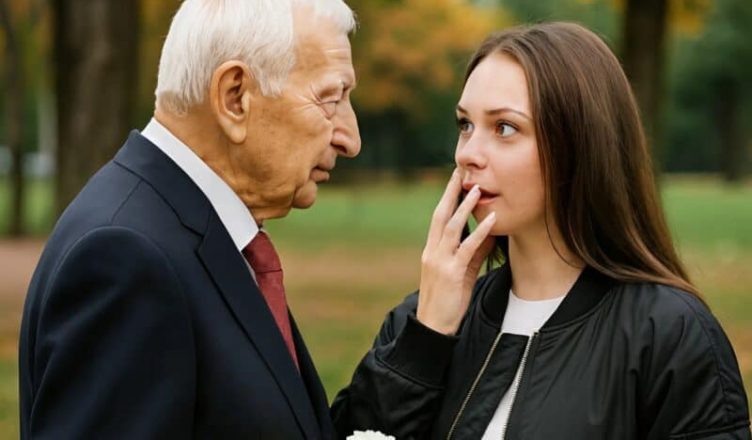
She lay beneath a gilded ceiling in the vast bedroom of the mansion, listening to the old man breathing beside her. His breath came in short, uneven sighs. She even wondered if his heart might fail before morning.
And that thought didn’t horrify her — it simply felt like the clock speeding up.
But by the following day, everything began to unravel.
A stranger arrived at the mansion — tall, composed, with a quiet authority in the way he moved. He stepped across the marble floors as though they were familiar to him, not foreign.
“Who are you?” she asked sharply.
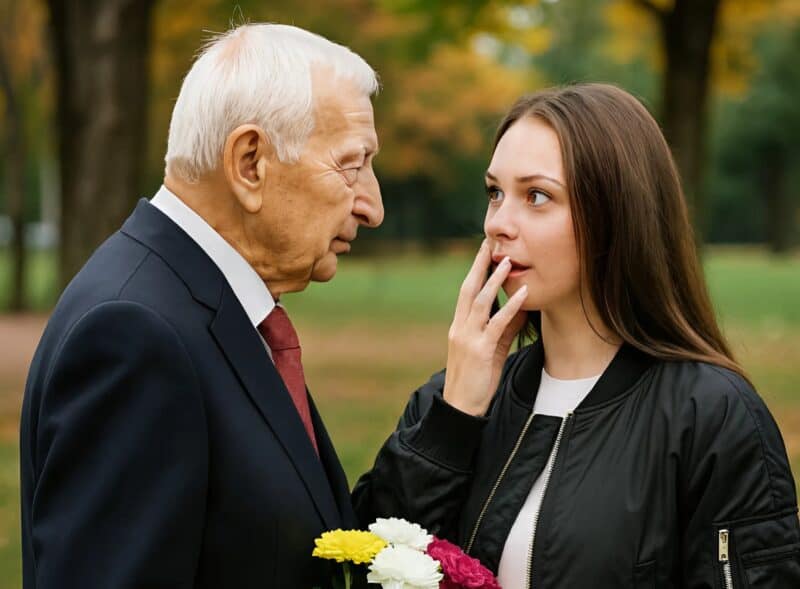
“I’m his legal guardian,” he replied. “And the representative of those who are meant to receive his estate.”
Her pupils widened.
“What estate?! He told me he had no one — no family, no heirs—”
“Or perhaps that’s what you preferred to believe,” he said evenly.
For the first time, she felt a crack of dread.
Later that afternoon, the old man regained consciousness and asked to see both her and the stranger.
His voice no longer sounded like the soft murmur of an enamored groom — it had cooled, sharpened.
He looked at her with clear, steady eyes.
“You really thought I didn’t understand why you married me?”
A rush of heat burned across her face.
This wasn’t guilt — it was exposure.
“I hoped,” he said wearily, “that comfort and kindness might reach you. That living among beauty might bring out something good in you…
But it seems I was mistaken.”
She tried to respond — a denial, an excuse — but he gently lifted a hand.
“I have no children, that part is true. But I do have people I trust.” He nodded to the guardian. “And my assets have long been transferred to a foundation. They will fund education, medical assistance, and aid for the truly vulnerable.”
She stared at him, stunned.
“And me?” she asked in a thin voice.
“You?” he echoed softly.
“You’ll receive exactly what you are ready for.”
He pointed toward a sealed envelope.
Later, behind closed doors, she tore it open with shaking fingers.
Inside were only a few lines:
“You were given a chance to transform yourself,
but you only tried to transform your lifestyle.
Leave this house. Find work. Build something real.
If one day you return as a genuine person, not a collector of benefits—
then we will speak again.”
Her heart sank.
Anger, humiliation, disbelief — they all collided at once.
But beneath them was something new — a quiet sting of truth.
She left that very evening.
No diamonds, no credit cards, no servants.
Just a modest suitcase and her own two hands.
The world outside was raw and unsentimental:
late shifts, cheap housing, demanding customers, endless fatigue.
At first she resisted it.
Then she tolerated it.
Then she learned from it.
And eventually… it reshaped her.
She went back to school.
She volunteered.
She discovered respect for effort, sincerity, and earned success.
And three years later, she returned to the mansion —
not as someone waiting for a windfall,
but as someone who finally stood independently.
The old man looked at her with a long, steady gaze — and smiled.
“Now,” he said, “I see a woman — not a hunter.”
And she realized that day:
he had never intended to leave her money.
He intended to leave her something far greater —
the chance to become worthy of respect, even her own.
Sometimes the richest inheritance isn’t gold —
it’s the evolution of the soul.