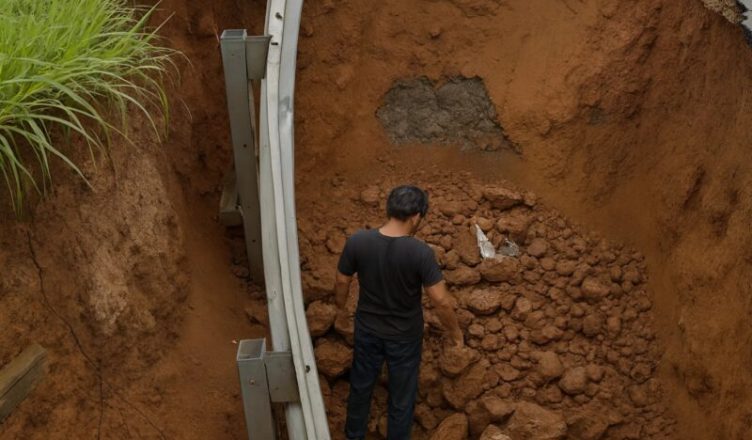
Minutes later, social media filled with photos: a massive portion of the highway had collapsed, leaving behind a raw, gaping hole in the earth.
The road that normally carried endless streams of cars now ended abruptly over an abyss. Police, emergency services, and engineers rushed to the scene. The public was pushed back behind barricades, warned of a possible second collapse, yet every eye stared downward — into that jagged red-brown pit where solid pavement had once been.
Specialists clipped into harnesses and began descending. Their flashlights wandered over tangled cables, shattered concrete, twisted steel.
And then they spotted something that froze them in place.
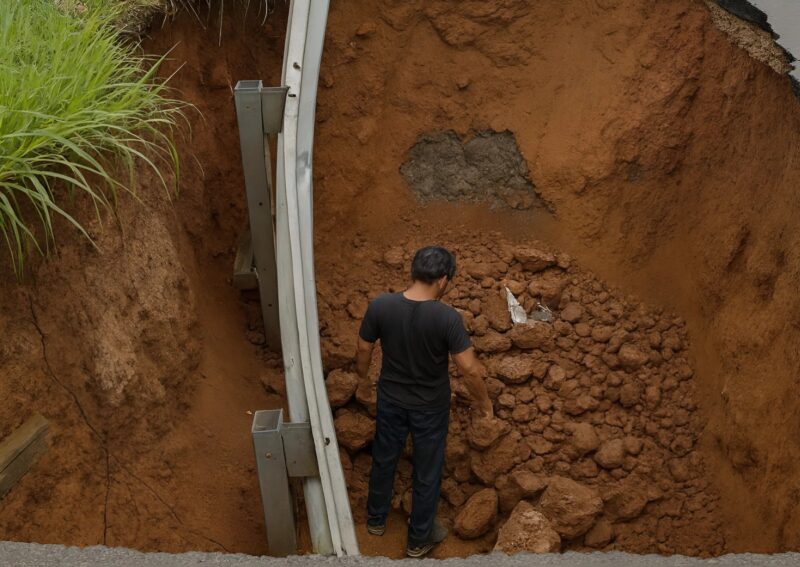
What first seemed like random wreckage was actually part of a concrete wall — unmistakably constructed by human hands. The outline of a doorway was still visible, though whatever once filled it was gone.
— Someone built something beneath this road, — one engineer whispered.
Another swept his flashlight along the soil and uncovered a corner of a metal plate half-embedded in clay. They pried it loose and brushed it clean.
On its surface were the words:
“OBJECT No. 47 — RESTRICTED ACCESS.”
Someone up top yelled:
— Did they find something? What’s down there?!
But the men below didn’t answer. One of them simply lifted his radio and said:
— We have an underground structure. Possibly a decommissioned facility. Requesting expansion of perimeter and immediate consultation with historical archives.
The quiet that followed felt strange — heavy, almost deliberate — as if the entire city was holding its breath.
Additional searchlights were lowered into the pit. Their stark white beams revealed the truth: beneath the highway was an entire hidden complex.
Corridors. Chambers. Support columns. Old piping. Rust-covered equipment. Even remnants of desks and filing cabinets — suggesting occupancy, not merely storage.
One of the workers stepped toward a side passage — and jerked to a stop.
On the ground lay personal belongings:
a leather journal, a dented metal flask, a torn piece of clothing.
All of it decades old.
— Someone lived down here… — he murmured.
The journal was opened. A voice read quietly:
— These pages are from… 1978.
That revelation spread quickly. The rumors started instantly:
— It was classified!
— It’s a Cold-War facility!
— We’ve been walking over this for decades!
— Is the rest of the area unstable?!
But that wasn’t the last surprise.
Behind a corroded panel in the main chamber, they found an old control board. Most of its indicator lights were dead and silent — except one. A tiny red diode was still glowing faintly.
At the same time, from somewhere deeper inside, came a slow mechanical whir — as if an ancient system had just awakened.
The engineers exchanged glances.
— It’s still receiving power. Something is still functioning.
That was the moment when the true realization set in:
for years — maybe decades — something had been quietly operating beneath everyday life.
By evening, roads were closed, reporters were removed, and access to the area was strictly controlled. People traded theories:
— A secret safehouse.
— A hidden laboratory.
— A surveillance center.
— A lost piece of infrastructure.
— An emergency refuge.
— A storage vault.
But late at night, long after the crowds were gone, unmarked black vehicles arrived. Men in dark uniforms descended into the pit — and the strange hum of activity began again below.
Whether the full truth will ever be made public — it’s impossible to say. But now, anyone who passes that stretch of road feels a silent unease, a quiet awareness that the world beneath our feet may be more complex than we imagine.
It’s not the collapse itself that frightens.
It’s what it revealed.
And a quiet, unsettling question remains:
How many more forgotten places are still hidden below our cities — waiting for one accidental moment to