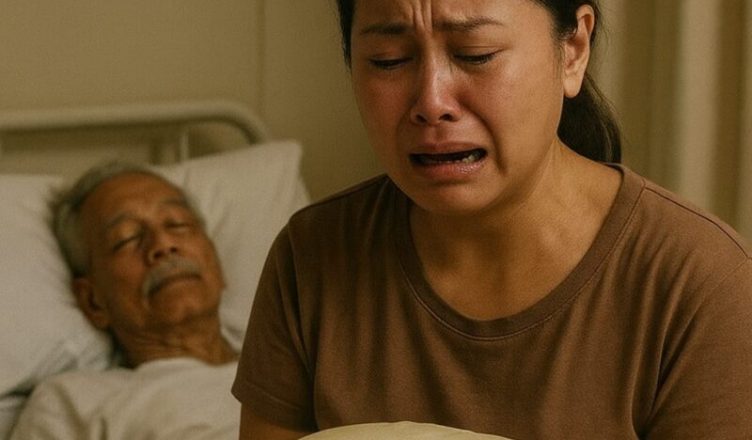
And on the final morning of his life, when the world around him was already fading, he reached for a torn pillow he’d slept on for decades, pressed it into my hands, and whispered:
“For… Maria…”
I never imagined how those two fading syllables would unravel everything I thought I knew.
My name is Maria. I married his son at twenty-six and walked into a family that had already been scraped raw by life. My mother-in-law had died young, leaving Tatay Ramon to raise four children alone while earning barely enough to keep one lamp burning. His hands were carved by the rice fields of Nueva Ecija. His back bent early. His spirit never broke.
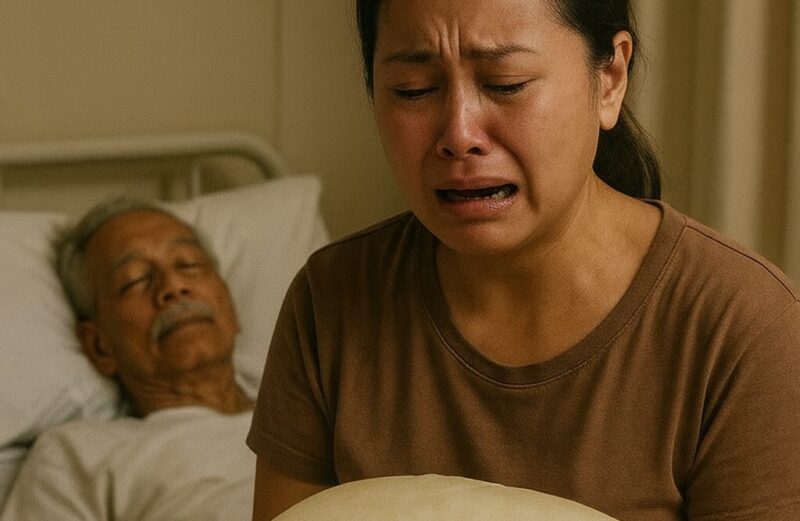
By the time I entered their lives, almost all of his children had drifted away, each swallowed by their own storms. And somehow, caring for him fell to me.
Neighbors whispered whenever they saw me carrying him outside or feeding him soup:
“Poor girl… she’s just the daughter-in-law. How long can she keep this up?”
But I never saw myself as a victim.
This man had given everything he had to his children.
How could I turn my back?
Still — the years took their toll.
My husband spent most weeks in Manila, and I juggled a toddler with an elderly man whose body weakened every sunrise. I cooked, washed him, held him during long nights when pain clawed at his ribs.
One evening, exhausted to the bone, I whispered:
“Tay… I’m only your daughter-in-law. Sometimes I can barely breathe.”
He squeezed my hand with a gentleness that felt like it came from a lifetime ago.
“I know, anak… That is why I thank you more. Without you… I’d already be gone.”
Those words never left me.
From then on, I made it a mission to soften the weight of his days — warm porridge when his stomach turned, foot rubs when his legs cramped, thick blankets when the cold months bruised his bones.
I never expected a reward.
He became my father in every way that mattered.
When he reached ninety-five, his heart surrendered.
That morning, already halfway out of this world, he called me close. His hands trembled as he pushed that worn pillow into my arms.
“For… Maria…”
Five minutes later, the room fell silent.
That night, at the wake, I finally opened the pillow.
The moment the stitches tore, something solid slid out — wrapped in old cloth, hidden so deeply it had become part of the fabric.
My stomach tightened.
Inside were bundles of letters — yellowed, soft, trembling with time — and one envelope on top addressed in shaky handwriting:
“To Maria. When the time is right.”
My hands shook as I opened it.
His voice spilled out across the page — raw, real, painfully honest:
“Daughter,
I leave this world not with money, but with debts of the heart.
You were the only one who stayed when my own children turned away.”
Then the shock hit like a punch:
“Everything your mother-in-law and I kept quiet — every piece of land, every title they think is gone — is yours.
Not theirs.
Yours.”
I froze.
Land he never mentioned.
Titles no one believed still existed.
Documents proving he had far more than anyone imagined… and that he’d trusted only me with the truth.
His final words felt like a second heartbeat inside my chest:
“You cared for me out of love, not duty.
Love is the only currency worth anything.
I leave everything to you, the daughter I found at the end of my life.”
I lifted my head.
Across the room, his children stared — whispering, calculating, already sensing a shift in the air.
They had no idea what was coming.
But I did.
And as I held the envelope — the truth, the inheritance, the confession he’d carried for decades — only one thought burned inside me:
“Yes, Tay… I will protect your last wish.
Even if it sets the whole family on fire.”