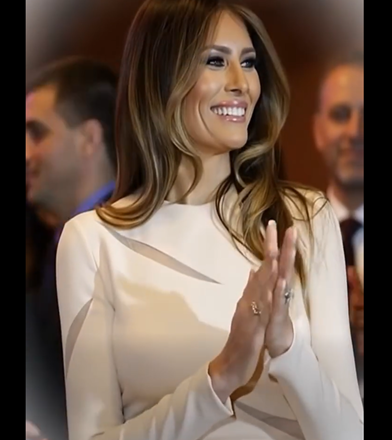
But instead, it struck the nation like a quiet explosion. People didn’t just look at it; they reacted as if something inside the picture was staring back at them.
At first glance, the portrait is harmless: soft shadows, muted tones, a gentle, almost weary smile. Yet the moment it went public, the air changed. It felt as if the country collectively inhaled — and didn’t exhale.
Why?
Because something in her expression refuses to stay still.
It’s the eyes. They look calm, yes, but not empty — they hold a glimmer of something raw, something too real for a curated political image. And then there’s the shadow beneath her cheekbone, the one detail everyone keeps arguing about. A small mark, almost accidental… yet impossible to ignore.
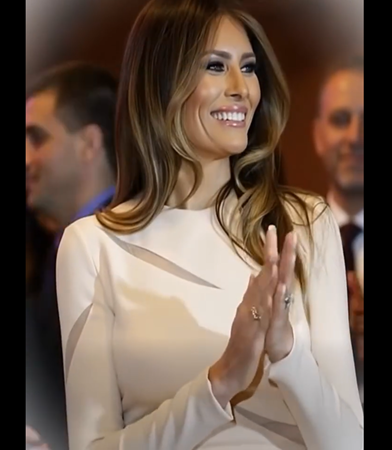
Some say it’s a sign of illness she’s hiding.
Others insist it’s the strain of her husband’s administration breaking through the façade.
A few whisper about a private tragedy the public was never told about.
But the most unsettling theory — the one people avoid even voicing — is painfully simple:
that the shadow is the truth everyone tried to paint over.
The portrait should’ve been just another ceremonial image.
Instead, it feels like a confession.
Commentators tore it apart, frame by frame. Critics claimed the artist slipped in a coded symbol — a blurred shape in the background that looks disturbingly like a hand reaching out. A trick of the light? Probably. But the fact that people are even considering such ideas says more about the public psyche than the painting itself.
This isn’t about the First Lady anymore.
It’s about a nation that suddenly saw vulnerability where it expected perfection.
Her composed smile doesn’t reassure — it unsettles.
Her posture doesn’t project strength — it hints at someone holding herself together because collapsing is not an option.
And that is what shocked people most: the reminder that power is worn by fragile human beings, not statues.
The debates rage on:
Is she signaling something?
Is there a hidden message behind the brushstrokes?
Is the shadow a warning?
But maybe the real warning is this:
a society that demands flawless leaders eventually forgets what a real human face looks like.
The portrait became viral not because of its beauty, but because of the discomfort it awakened. A single image cracked the illusion — and from that crack spilled every fear the public tried to suppress.
Now the First Lady stands in the center of a storm she never asked for, holding a gaze that feels almost defiant, almost pleading, almost… prophetic.
And the question that lingers, sharp as glass, is simple:
What truth was she trying — or forced — to carry into that portrait?