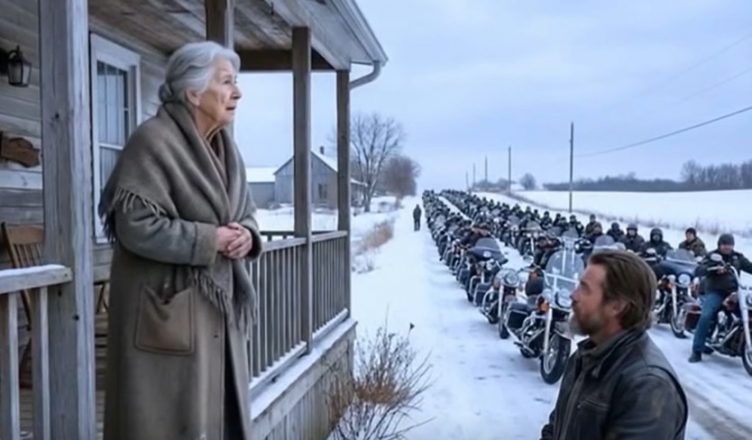
Her house, a lonely wooden box on the edge of the forest, shook under each violent gust. She wrapped her hands around a mug of cooling tea and wondered if anyone else in the world was still awake.
Then came the knock.
Not desperate — worse.
Hesitant. Weak. The kind of knock made by someone who no longer expects the door to open.
Her heartbeat thudded in her throat. No one should be outside. No one should even be alive out there. Still, she reached for the latch, feeling the cold radiate through the door like a warning.
When she opened it, the wind threw two bodies into her hallway. A man and a young woman, stiff with cold, eyes wide with the kind of fear that settles in the bones. The girl’s voice cracked when she tried to speak; the man didn’t speak at all. Their fingers were white, almost translucent.
She could have stepped back. She could have done what most people secretly do — protect herself first, rationalize her fear, pretend she didn’t hear the knock.
But something in their faces — something raw and unbearably human — tore through her hesitation.
“Come in,” she said, though part of her whispered the opposite.
They collapsed near the fire. Steam rose from their clothes as the ice melted, and with it came the smell of wet fabric, smoke, and something else — something like survival clinging to life by a thread. She wrapped the girl in her old wool blanket, one she hadn’t touched since her mother died, and felt the tremor in the girl’s shoulders slowly fade.
By morning, they were stable. Grateful. Embarrassed by their own helplessness. They left quietly, promising to return one day and repay her kindness.
She didn’t believe they would. People like them rarely do.
What she didn’t expect was what happened next.
The following weekend, she opened her curtains — and froze.
The road to her house was no longer empty.
It was a river of people.
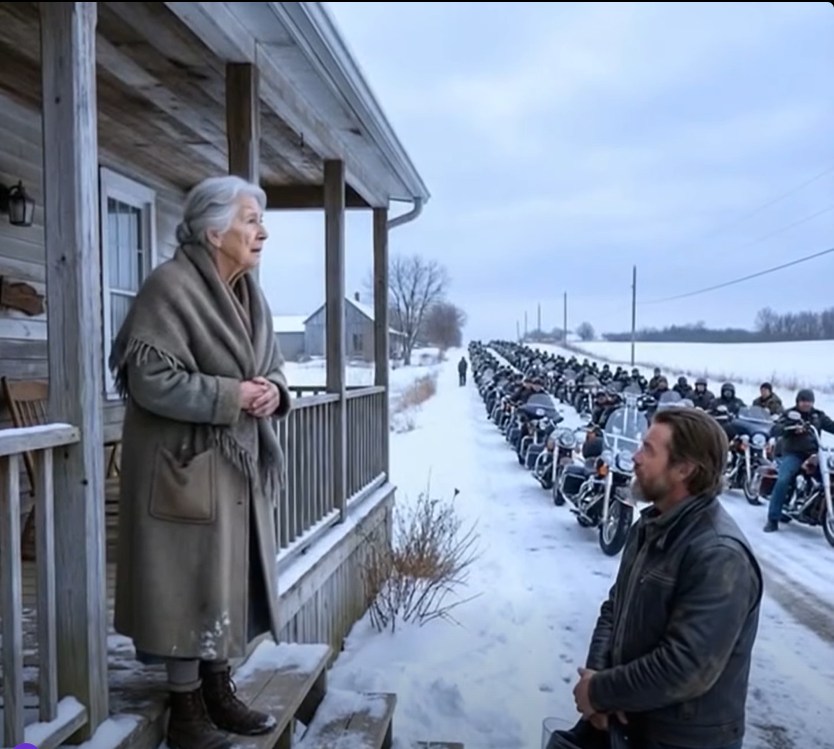
Dozens at first. Then hundreds. Walking through the snow with flowers, handwritten notes, photographs, candles. Strangers. Families. Elderly couples leaning on canes. Children carrying drawings made in crayon.
When she stepped outside, the crowd parted as if she were someone sacred.
A woman approached her, tears thawing on her cheeks.
“They told us what you did,” she whispered. “Most of us… we didn’t believe anyone would still open their door on a night like that.”
The murmur of the crowd rose — soft, trembling, overwhelming.
People weren’t just thanking her.
They were confessing.
One said he had ignored screams once.
Another admitted she had pretended not to see a freezing man on the street.
A third said he always locked the door when anyone knocked after midnight.
They came to her not only to thank her — but because her one small act exposed something they had all tried to hide: their own fear, their own avoidance, their own guilt.
And then she saw them.
The man and the young woman stood together, alive, warm, transformed. He held her hand. She held a small wooden sign.
“We wanted you to see this first,” the girl said, her voice steady now.
The sign read:
THE HAVEN — Founded in Her Honor
“We’re opening a shelter,” the man said. “For people caught in storms — real and otherwise. Because that night, you didn’t save only us. You forced the world to look at itself.”
She felt something inside her shift — as if the storm she had feared so deeply had finally broken, not outside, but within her.
The snow around them glittered in the sunlight, no longer cold, but strangely alive.
And she understood:
Sometimes a single open door can shake an entire world awake.