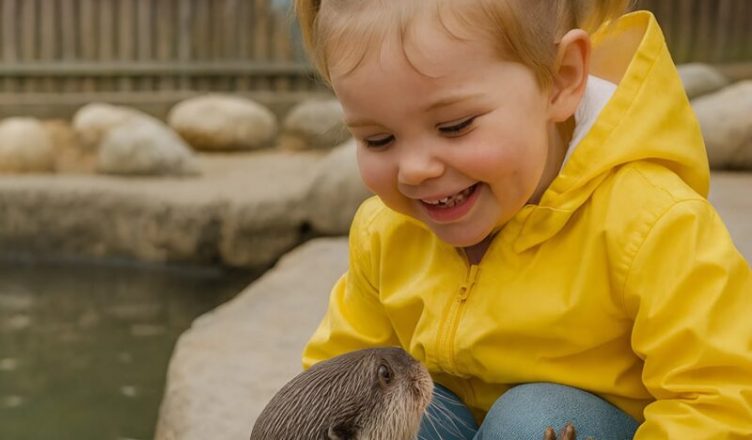
The zoo employee chose his words with deliberate care:
— Luna isn’t just an ordinary otter. She’s part of an ongoing research project. Her sense of smell is extraordinarily sensitive… to the point that veterinarians believe she can detect subtle chemical changes in a human body — especially in children.
The mother blinked, confused:
— I’m sorry… what exactly are you suggesting?
He continued gently:
— She’s been trained to recognize specific scent markers — indicators of inflammation and certain illnesses. We’ve verified her reactions in clinical conditions.
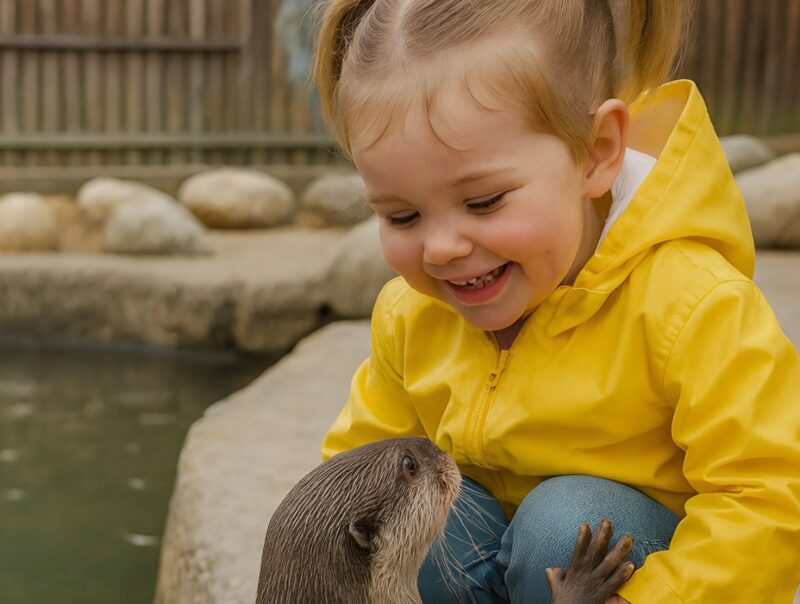
The father’s expression shifted from surprise to dread:
— Are you trying to say that she sensed something wrong with our daughter?
The man nodded:
— She stopped playing, didn’t she? She touched a particular area on her body repeatedly? Then circled around her? She only does that when she detects a potential warning sign.
Instinctively, the mother wrapped her arms around her daughter. The girl stared up at them, puzzled and innocent.
— What kind of sign? — the mother asked quietly. — Is it something contagious? Something from the animals?
And then came the words that hit like a blow:
— Luna reacts to early biochemical markers linked to cancer-like processes.
A wave of cold washed over the parents.
— What? — the father said hoarsely. — Are you telling us our little girl might have…
The employee raised a calm hand:
— I’m not diagnosing anything. But Luna hasn’t been wrong once in the last two years. Every child she reacted to like this was later found to have an early-stage condition that required medical attention.
The mother shook her head in disbelief:
— But she looks perfectly healthy. She laughs, she runs…
— That’s exactly why this matters, — he replied softly. — Children often show no outward symptoms at the beginning. But animals can detect chemical trace signals long before doctors can.
The father knelt down to the girl’s eye level:
— Honey… do you ever feel pain anywhere?
She hesitated, then nodded slightly:
— Sometimes… my tummy hurts. But just a little.
Suddenly that “little” didn’t feel small at all.
The mother’s voice trembled:
— We’re taking her to a doctor today.
The employee nodded firmly:
— That’s the best decision. If it turns out to be nothing — wonderful. But if not… you’ll be grateful you didn’t wait.
In the car, staring out the window, the girl asked in a small voice:
— Mom… is Luna a nice otter?
The mother squeezed her hand:
— Yes, sweetheart. She’s a very special otter.
And the father thought: sometimes the guardians we need don’t wear masks or stethoscopes — they swim silently beneath the water and simply feel what we cannot.
Two days later, the test results confirmed it: the earliest stage of a small, developing tumor.
Not advanced.
Not dangerous — yet.
But real.
The doctors said:
— You caught this at the perfect time. Treatment will be effective.
The mother cried tears of relief — the kind that come from knowing disaster was narrowly avoided.
Weeks later, when the girl began recovering, they returned to the zoo.
Luna approached again — slowly and peacefully — and rested her head against the stone.
No circling.
No tapping.
No alarm.
Just quiet presence.
The girl knelt beside her and whispered:
— Thank you.
And maybe — just maybe — Luna understood.
Because sometimes the deepest form of understanding isn’t spoken in language…
but sensed in silence, instinct, and connection between living beings.