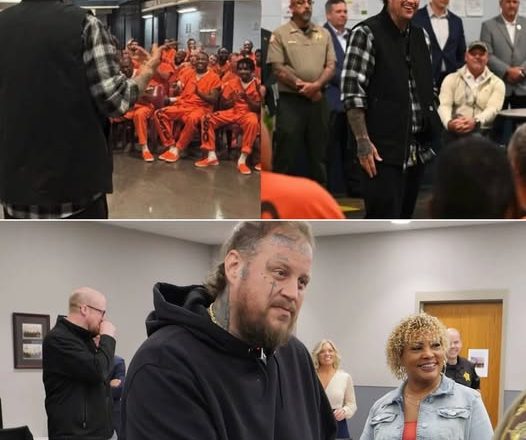
Jelly Roll is unmistakably one of those.
It happened on a quiet, unremarkable morning at a correctional facility — a place where days usually blur into one another. The inmates were ushered into the gathering hall with the usual routine. No one told them why. The guards themselves exchanged uncertain glances.
Then he appeared.
No stage lights, no ego, no entourage. Just a simple hoodie, a worn baseball cap, and an expression of sincerity. He didn’t walk in like a celebrity — he walked in like someone who remembered the taste of confinement.
Some inmates recognized him immediately. Others simply felt his presence.
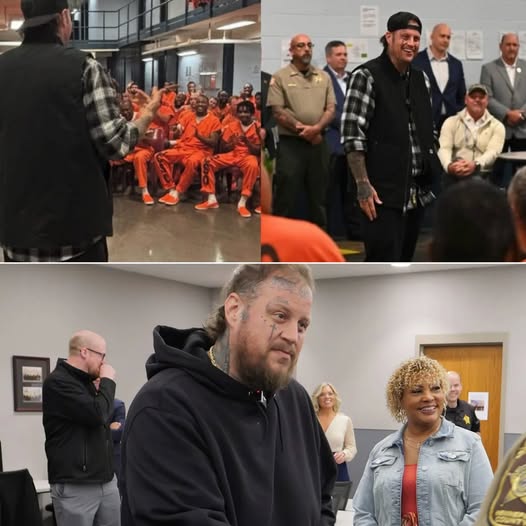
The room fell into a stillness that was different from the usual forced silence — it was the silence of attention.
He didn’t open with a dramatic speech or a sermon. He just said, with a calm voice:
“I’m not here to talk down to you. I’ve made my mistakes too — more than I can count.”
And then the music started.
Every note seemed to carry a memory — of addiction, of loss, of second chances scraped together by sheer willpower. It wasn’t an act. It was vulnerability, raw and unpolished.
At first the audience listened guardedly. Arms folded. Faces stern. Emotions locked up tight. But something began to shift.
A few heads dipped.
A few brows furrowed.
A few eyes closed — not from boredom, but from recognition.
Some men blinked away tears they hadn’t planned on showing. Others let single tears roll freely, not caring who saw.
One particularly intimidating inmate — tall, broad, etched with ink and reputation — approached the front. Instead of presenting bravado, he spoke quietly:
“You reminded me I’m not beyond redemption… that I’m still human.”
That sentence carried more weight than any applause.
Then came the surprise.
Jelly Roll hadn’t just brought music — he brought letters. Personal letters written by people on the outside: former inmates who rebuilt their lives, parents of incarcerated sons, volunteers, strangers who still believe in forgiveness.
These weren’t fake “stay positive” clichés. They were real voices, shaky handwriting, sometimes messy emotion.
Some men clutched their letters like lifelines.
Some reread them over and over.
Some couldn’t even finish the first paragraph without swallowing hard.
Even the guards softened. Their stiff posture eased. The distance between uniform and inmate seemed to shrink, if only for a moment.
When Jelly Roll finally stepped back through those secured doors, the facility didn’t suddenly become a sanctuary of hope or enlightenment — life doesn’t work that fast. But something had shifted.
Change rarely begins with shouting or orders.
It begins with recognition — the recognition that a person’s worth isn’t erased by their worst moments.
He showed them — and us — that compassion can reach places punishment never did.