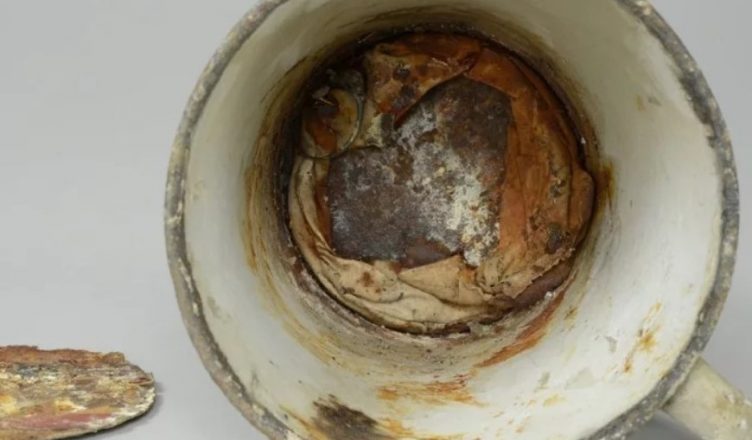
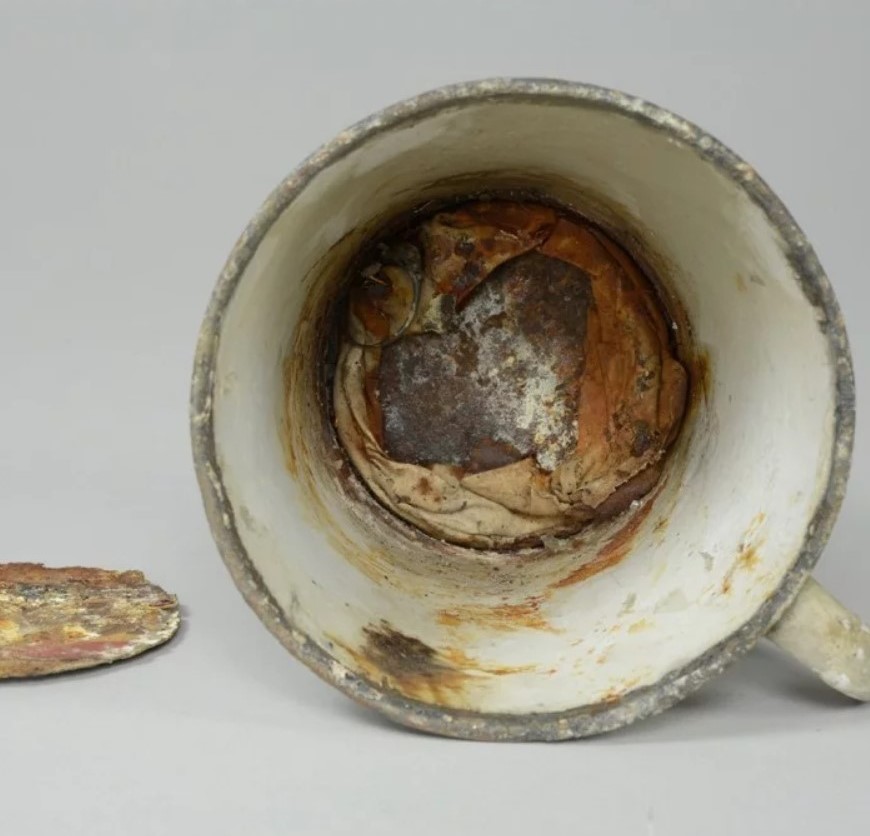
A curator at Auschwitz was examining a simple enamel cup — one of many, unremarkable at first glance — when he sensed a hollow echo inside. A subtle seam. A difference in weight.
Gently, he pressed against the inner surface — and the bottom shifted open as if exhaling a secret kept for seventy years.
Inside lay small objects that suddenly made the past intimate: a slim silver ring with almost-erased engraving, a modest house key, and two tiny gold earrings wrapped carefully in a scrap of cloth. These weren’t random remnants — they were intentionally hidden. Protected. Almost cherished.
It raises a question that lingers in the mind: what kind of courage and belief does it take to carry a house key into a place where almost no one ever returned home?
The museum staff didn’t immediately assign explanations — but the logic is human, not technical. Someone hoped. Someone resisted the erasure of their identity. Someone believed that love, memory, and home still mattered — even when everything else was being stripped away.
That ring likely symbolized a bond. The earrings — a last link to beauty, family, normal life. The key — a promise of return, or at least a refusal to accept finality.
Picture the moment: a crowded transport wagon, the uncertain future, the trembling fingers carefully opening the cup, placing those treasures inside, sealing it shut with a quiet determination — as if saying,
“This will survive even if I don’t.”
Today those objects are not merely artifacts. They are testimonies. They are fragments of real lives and real hearts. They show that even when a person is reduced to a number, the inner world — memory, hope, identity — remains beyond reach.
And perhaps the realization that hits the hardest is this: the cup was not hiding wealth… it was protecting humanity. It was preserving a whisper of life in a place designed to extinguish it.
As if history itself waited for someone to finally open that secret compartment and hear it say:
“Remember us. Not as victims — but as people.”
If you’d like this adapted for a specific target — American, British, French-English, more journalistic, more poetic, or more documentary-style — I can adjust the tone accordingly.