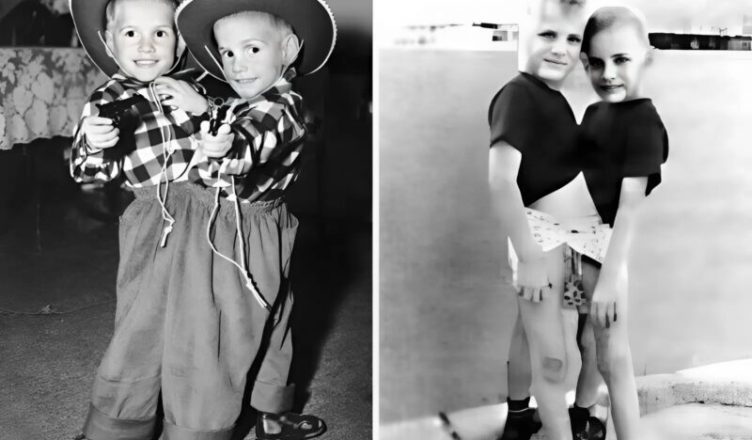
Some froze, some stared, some whispered — because the world gets uncomfortable when it meets something it can’t explain away. But the twins figured out a brutal truth early: if you want to survive, you can’t wait for people to understand you. You build your life anyway. You fight for it anyway.
Born on October 28, 1951, in Dayton, Ohio, they came into the world fused at the abdomen and pelvis, sharing organs no surgeon could safely separate. Doctors spoke in soft, cautious tones; nurses avoided making promises. The phrase “They won’t live long” hovered over their childhood like a storm cloud that never burst.
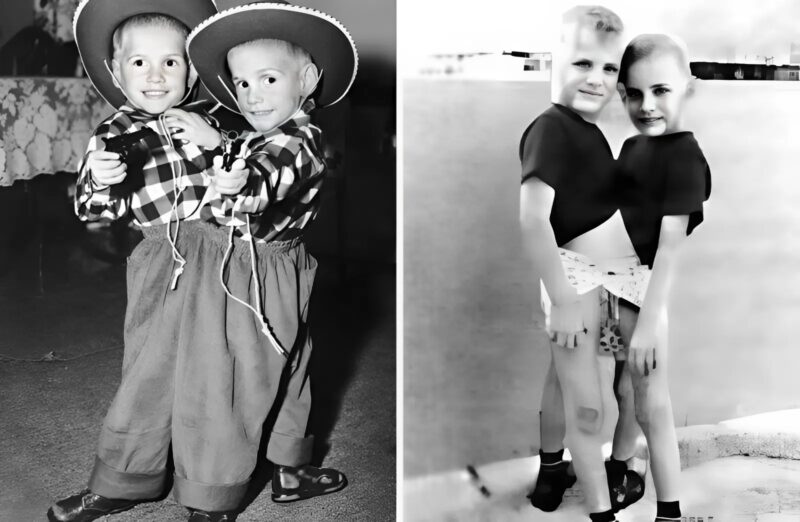
But these boys didn’t bend under that weight. They ignored it — or maybe they simply outgrew it.
They fought, they laughed, they shoved each other verbally the way all brothers do. Except they couldn’t walk away to cool down. They shared every step, every turn, every inch of momentum. Imagine arguing with someone who literally cannot leave the room — that was their childhood.
And yet, five minutes later, the same house would shake with their hysterical laughter.
That was their secret: frustration never outlasted love.
By the time they hit eighteen, the warnings grew more dramatic. Their bodies are too fragile. They won’t handle adulthood.
But the twins decided long ago that their lives wouldn’t be lived inside hospital predictions.
They worked the carnival circuit, not as victims on display but as men who wanted independence. They earned their own income, traveled state to state, saw more of America than anyone ever expected two fused bodies to see. People came to stare — sure — but the twins stared right back with a look that said: We’re not your tragedy. We’re our own story.
And the years kept coming.
They made friends. They got into stupid neighborly arguments. They blasted radios too loud. They joked about whose singing voice was worse. They lived a life stitched with small, stubborn acts of joy — the kind that make survival feel less like a miracle and more like a victory.
And then came the twist no doctor dared predict:
They grew old.
Not “older than expected.”
Old.
Sixty-eight years old.
Two men who weren’t supposed to survive infancy ended up becoming the longest-living conjoined twins in recorded history. Their bodies hurt, sure. Age carved its initials into them early and deeply. But their eyes? Their eyes stayed young — mischievous, unbroken, defiant.
During an interview, someone once asked them:
“Did you ever wish you had been separated?”
They exchanged that private, silent look — the kind only two people who shared every breath for nearly seven decades can understand.
“No,” they said.
“We were never alone.”
And that answer landed like a punch to the chest.
Because their story was never about deformity or limits.
It was about connection — the rare kind that refuses to snap no matter how hard life pulls.
In their final years, they sat side-by-side in rocking chairs, listening to old country songs, teasing each other, laughing at the doctors who once predicted doom.
Their smiles weren’t miracles.
They were acts of rebellion.
Sometimes the most shocking story isn’t the one filled with tragedy — it’s the one where people beat every odd simply by choosing to keep living.