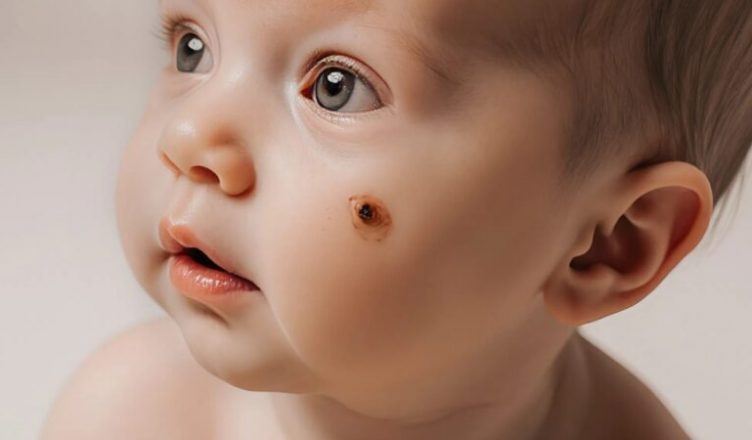
She studied my child for a long moment before finally speaking.
“She’s incredibly alert,” she said, her voice low and certain. “Give her time… she’ll grow into a presence people won’t be able to ignore.”
I laughed softly, not because it was funny, but because my heart was too full to hold anything else. How could something so tiny feel like a declaration from the universe?
The delivery room felt unreal that day. Newborn cries echoed like distant birds, antiseptic stung the air, nurses moved with soft urgency. And in the middle of it all, I held her — my daughter — whose fingers closed around mine as if she’d been waiting her whole life just to do that.
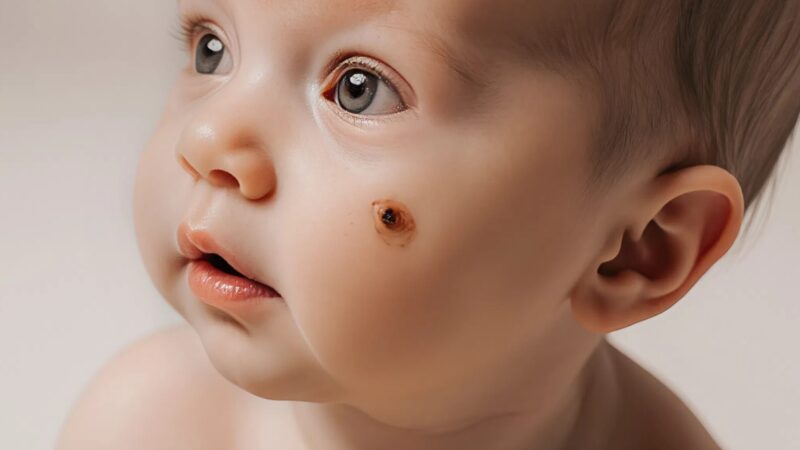
But when the nurses cleaned her and wrapped her, something pulled my eyes toward her cheek.
A dark, noticeable beauty mark. Not delicate. Not faint. It stood out against her newborn skin like ink on snow.
My breath caught.
Was this going to make her life harder?
Would people stare?
Would kids ask cruel questions?
Would it change how she saw herself?
Would it change how I saw her?
That last question hit like a punch.
I watched her for hours, searching — not for flaws, but for reassurance. And all I saw was her tiny nose, her soft lips, the shimmer of a soul not even a day old. But the doubt stayed anyway, stubborn and poisonous.
I imagined her first day of school.
The quick glances.
The strange questions.
The whispered comments kids don’t realize are sharp enough to scar.
And then the ugliest fear surfaced:
What if one day she catches me looking at her the same way?
Even for a second.
Even by accident.
That possibility terrified me more than anything strangers could ever say.
Late that night, the room finally quieted. The air hummed with the sterile glow of fluorescent lights. She slept in her bassinet, her tiny chest rising and falling, and that mark on her cheek seemed to glow with its own message.
Not a warning.
Not a flaw.
A question.
Can you love me without hesitation?
Can you love yourself enough to teach me how?
I reached out and touched it — gently, like it might vanish if I pressed too hard. And something inside me cracked open. That mark wasn’t the problem.
My fear was.
But fear has a way of whispering relentlessly:
People will judge her.
People will question her.
People won’t understand her.
Then came the cruelest whisper of all:
Will you?
I wanted to be the parent who says, “You’re perfect just as you are.”
But before I could teach her that, I had to mean it.
Really mean it.
I spent the night walking circles around her bassinet, trying to untangle my own reflection from hers. And then, somewhere between exhaustion and revelation, the truth came:
I wasn’t scared of her mark.
I was scared it might expose parts of me I never dealt with.
But when she stirred, her lips forming the faintest dream of a smile, everything shifted. Fear loosened its grip — just enough for clarity to break through.
Sometimes a newborn doesn’t need to say a word to teach you the hardest lesson of your life.
As I stood over her, I understood something with absolute certainty:
If I don’t learn to love the part of her the world might question,
how will she ever learn to love it herself?
This wasn’t her challenge.
It was mine.
And ready or not, I’m stepping up.